
Searching for free digital marketing training online usually means you want more than a list of videos. You may need to launch your first campaign for a local shop, manage an Instagram page, build a content plan, explain results to a client, or decide whether a paid course is worth your money. The seven options below are compared for that single buyer job: building usable entry-level marketing skills without committing to an expensive program at the start.
They are not identical products. Some are official training libraries for a specific advertising platform; others teach inbound marketing, SEO, design, or a broader workflow. That distinction matters. A Meta course can help you understand Meta advertising, but it will not by itself teach you how to price freelance services. An SEO academy can explain keyword research, but it cannot replace campaign practice.
For a fair comparison, each option is judged on five practical points: breadth of curriculum, hands-on usefulness, evidence of completion, implementation burden, and commercial access. “Free” means that meaningful learning content is available without paying at the time of writing in 2026; it does not mean every certificate, advanced feature, or related tool is free. Always verify the current course status, language, assessment rules, and pricing before planning your study schedule.
- Use case: learning enough to create and measure a real marketing workflow.
- Audience: beginners, students, social media managers, small-business owners, and freelancers in Egypt and Saudi Arabia.
- Selection rule: established services with an official learning destination, not random video channels or unverified course sellers.
- Important limitation: platform knowledge becomes obsolete when interfaces, policies, or campaign objectives change.
A sensible learner does not finish all seven. Choose one broad foundation, then add one specialist path linked to the service you want to sell or operate. For example, a small online store might combine a broad inbound course with Meta advertising and Canva design. A freelance SEO writer may need Semrush or Ahrefs more than advertising certification.
1. HubSpot Academy
What it teaches and where it fits
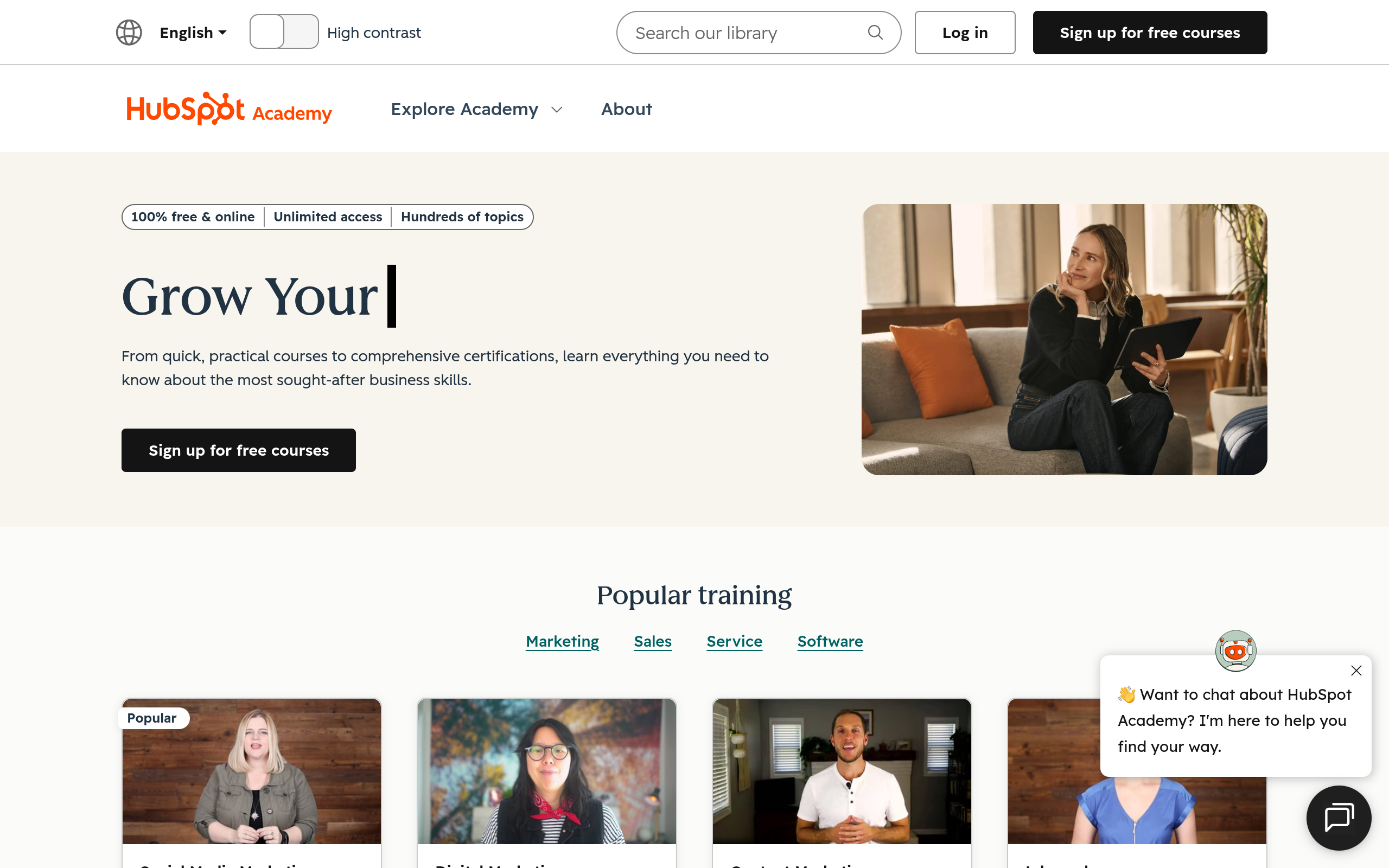
HubSpot Academy is a strong starting point for learners who need a broad marketing vocabulary rather than training on only one ad platform. Its learning catalog covers subjects associated with inbound marketing, content, email, sales, customer relationship management, and related business workflows. The official academy homepage is the correct place to check current courses and certification requirements.
Its main advantage is sequence. A beginner can move from attracting attention to capturing a lead, communicating with that lead, and thinking about retention. That is closer to how a small business actually operates than studying isolated post formats. For example, a home-based dessert business could use the lessons to define an audience, publish educational content, collect inquiries, and follow up instead of measuring likes alone.
Do not confuse a course certificate with proof that you can run a profitable campaign. The learner still needs to create a buyer persona, write several messages, build a simple content calendar, and interpret results. HubSpot’s own certification pages describe the course and exam process; check the current requirements directly at the certification overview because completion conditions can change.
Verdict, burden, and commercial model
- Best for: beginners who want a cross-channel foundation and business-oriented terminology.
- Does not suit: someone who only wants advanced campaign setup for one advertising platform.
- Standout: a useful bridge between content, leads, email, and customer journeys.
- Implementation burden: low for watching lessons; medium if you build the suggested assets in a real or simulated business.
- Commercial model: much of the academy content is available free, while HubSpot’s wider software ecosystem has separate plans and paid capabilities. Verify each course and certification page in 2026.
A practical assignment is to choose one Egyptian or Saudi small business, map its customer journey, and produce one landing-page outline, three emails, and a seven-day content plan. If you cannot explain what action follows each piece of content, return to the funnel rather than collecting another certificate.
2. Google Skillshop
What it teaches and where it fits
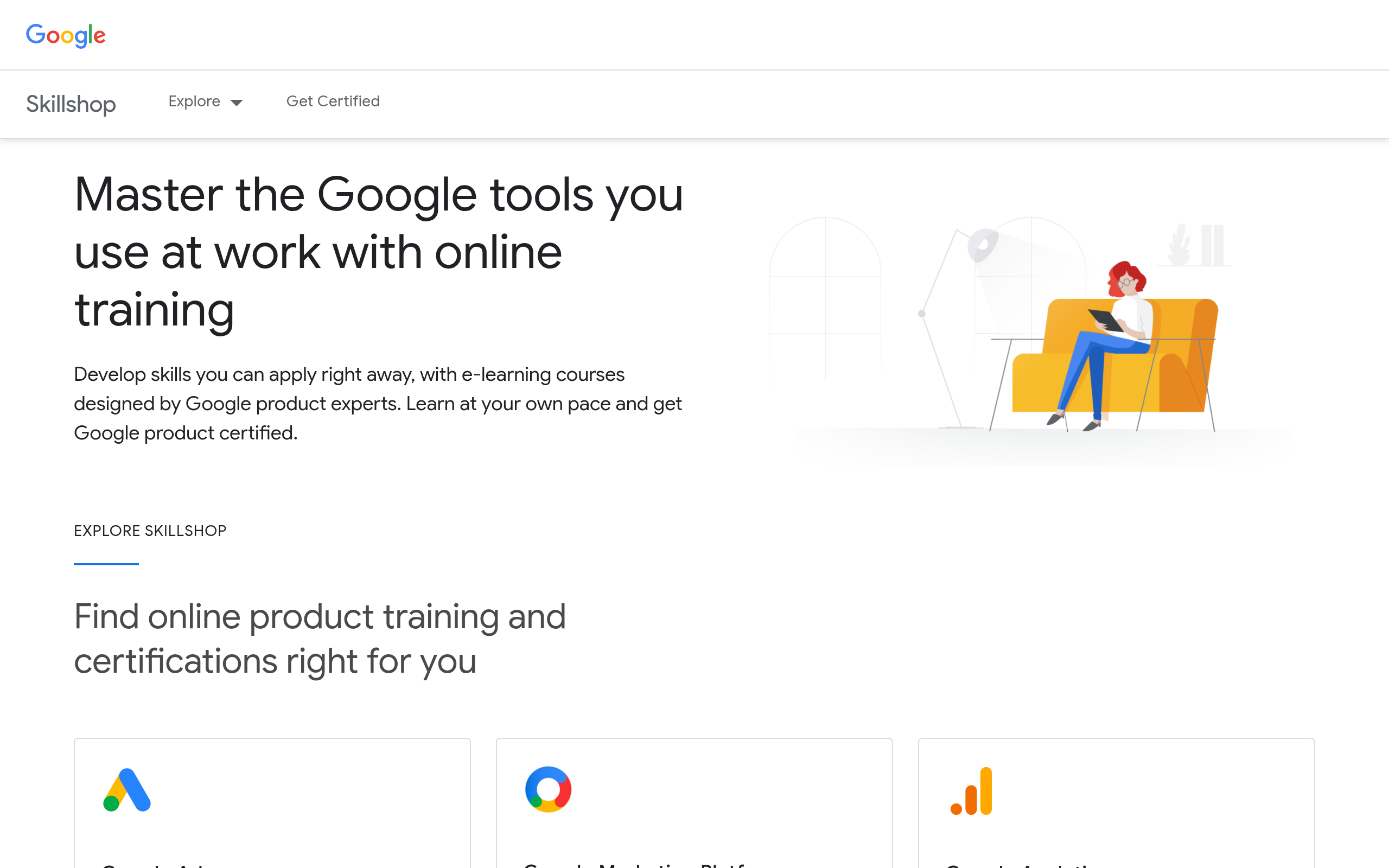
Google Skillshop is best understood as an official training and assessment environment for Google products. It is therefore narrower than a general marketing school, but particularly relevant to professionals who expect to work with Google Ads, measurement, or other Google marketing tools. Available learning paths and exams should be confirmed in the current catalog.
The important decision is whether your job involves Google’s ecosystem. A freelancer managing search campaigns for a dental clinic will benefit more from platform-specific learning than from a general introduction to social media. Conversely, a shop owner who has not yet defined an offer, landing page, or customer segment may be trying to learn campaign controls too early.
Google’s official Google Ads Help documentation explains campaign-related concepts and settings. Treat the documentation as a reference while studying, not as a substitute for practice. Build a mock campaign with a clear objective, keyword groups, exclusions, ad variations, landing-page relevance, and a measurement plan before spending money.
Operational trade-offs
- Best for: aspiring paid-search specialists, in-house marketers, and freelancers who will manage Google campaigns.
- Does not suit: learners seeking a complete content, branding, community-management, and creative curriculum in one place.
- Standout: direct proximity to Google product terminology and assessment routes.
- Implementation burden: medium; the interface, policy language, conversion setup, and reporting concepts require deliberate practice.
- Commercial model: learning resources and some assessments may be free, but advertising itself requires a client or practice budget. Never treat a free learning path as free media buying.
For a small e-commerce store, begin with a measurement question: “What counts as a completed order or qualified inquiry?” Then study only the campaign features needed to answer it. This prevents a common beginner mistake—learning bidding terminology before installing reliable conversion tracking.
3. Meta Blueprint
Platform specialization
Meta Blueprint is the relevant official learning destination for people working with Facebook and Instagram business activity, including advertising concepts, campaign workflows, creative choices, and platform practices. Meta’s business learning pages and exams can change, so use the linked destination to verify which courses and certifications are currently offered in 2026.
This option is useful when the buyer job is planning and operating Meta campaigns. A social media manager can study the relationship between an objective, audience, creative, placement, and result. A freelancer can also use the material to improve client explanations: reach is not the same as leads, and a low-cost click is not automatically a valuable business outcome.
Meta’s official developer documentation at Marketing API documentation shows how technical campaign management can become more complex when automation or integrations are involved. Most beginners do not need the API. The lesson is simply that a platform course does not cover every implementation problem, especially tracking, catalog quality, permissions, or custom automation.
Verdict for social media operators
- Best for: social media managers, paid-social beginners, and businesses whose customers are active on Meta platforms.
- Does not suit: a learner who needs SEO, email strategy, or broad marketing planning before choosing an advertising channel.
- Standout: platform-specific language for campaign objectives, creative, audiences, and measurement.
- Implementation burden: medium to high when you move from lessons to business-manager permissions, pixel or event setup, creative testing, and reporting.
- Commercial model: educational resources may be free; ad delivery, creative production, and any external analytics or implementation work have separate costs.
Use a controlled practice brief: one product, one audience hypothesis, two creative angles, and one primary conversion. Do not change audience, offer, creative, and budget at the same time. Otherwise, a beginner cannot identify what caused an improvement or a decline.
4. Semrush Academy
SEO, content, and search visibility
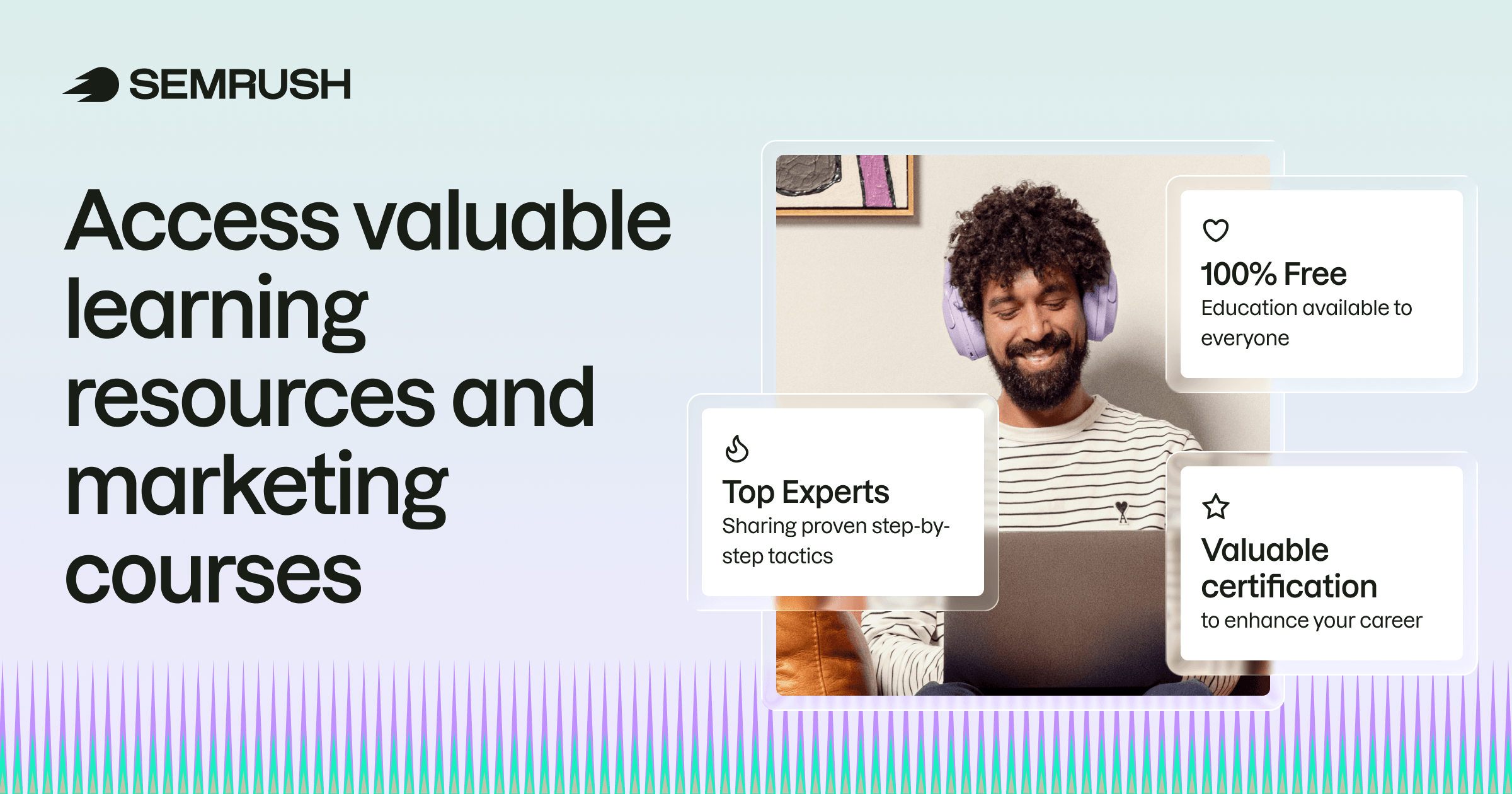
Semrush Academy is a specialist option for learners whose marketing work includes SEO, keyword research, competitive analysis, and content planning. It is not a replacement for advertising-platform training. Its value is strongest when your client job is to make a website easier to discover through search and to turn search intent into useful pages.
A content freelancer might use this path to move beyond “write an article about shoes.” The better workflow is to identify the searcher’s problem, inspect competing pages, group related topics, select a realistic target, and create a brief that specifies the reader’s next action. The tools associated with SEO can support that process, but tool output still needs human judgment about relevance, language, local context, and business value.
Semrush maintains an official knowledge base with product guidance. Use it to distinguish a general SEO concept from a feature that requires a Semrush account. The academy may teach a method even when executing every step in the product requires a plan or current account access.
Verdict, burden, and cost boundary
- Best for: SEO beginners, content strategists, bloggers, and freelancers building search-focused services.
- Does not suit: someone whose immediate job is creating daily social posts or managing Meta ad delivery.
- Standout: a connection between keyword research, content briefs, and search visibility.
- Implementation burden: medium; learning concepts is accessible, but auditing a real site and prioritizing fixes takes practice.
- Commercial model: academy education can include free learning, while Semrush software access and limits depend on the current product plan. Verify live pricing and feature access before promising an audit to a client.
A useful exercise is to select one local service, such as a Riyadh maintenance company or an Alexandria language center, and produce a keyword-to-page map. Include the user’s location, service intent, page type, internal-link destination, and conversion action. This creates a portfolio artifact more persuasive than a course screenshot.
5. Ahrefs Academy
Learning SEO as a repeatable process
Ahrefs Academy is another credible specialist route for SEO and content marketing. It is most useful for people who want to understand how search demand, backlinks, technical signals, and content opportunities fit together. The official academy page should be checked for the current course catalog and access conditions.
The difference from a broad marketing curriculum is depth of search workflow. A learner can practice moving from a business category to topic discovery, from topic discovery to a page brief, and from a published page to promotion and measurement. That workflow matters to freelance writers and SEO assistants who must explain why a page was created, not simply deliver a word count.
Ahrefs also publishes an official Help Center. Its documentation is useful for checking what a metric means and what a product report can or cannot establish. Do not present a third-party metric as a guaranteed ranking factor or revenue forecast; use it as one input among search results, analytics, customer questions, and commercial priorities.
Verdict for SEO freelancers
- Best for: learners pursuing SEO research, content strategy, link analysis, or website audits.
- Does not suit: a shop owner who needs immediate social-content production without a website or search objective.
- Standout: a process-oriented view of finding opportunities and connecting them to content work.
- Implementation burden: medium; portfolio-quality SEO work requires access to a site, spreadsheets, search-result analysis, and time for revision.
- Commercial model: academy resources may be free, while Ahrefs product access is a separate commercial decision. Confirm current limits and pricing before selecting it as your main research tool.
To make the training practical, audit three existing pages for the same business. Record the search intent, missing information, internal links, title and description quality, and the page’s commercial next step. A recommendation is only useful when the owner can implement it and measure a plausible outcome.
6. Canva Design School
Creative production for lean teams
Canva Design School belongs in this list for a different reason: many beginners do not fail because they lack marketing theory; they fail because they cannot turn a message into a usable visual quickly. Canva’s official design-learning destination can help social media operators understand layout, visual hierarchy, brand consistency, and content production. Verify the current lessons and access model on the official site.
This is a creative execution layer, not a full digital-marketing curriculum. It can help a Saudi café produce a readable offer post or help an Egyptian freelancer create a consistent set of story templates. It cannot decide whether the offer is attractive, whether the audience is profitable, or whether the post generated qualified demand.
Verdict and limitations
- Best for: small-business owners, social media assistants, and freelancers who need stronger visual execution without a full design degree.
- Does not suit: learners looking for campaign measurement, SEO research, conversion tracking, or media-buying strategy.
- Standout: it turns abstract design advice into repeatable templates and production habits.
- Implementation burden: low to medium; the tool is approachable, but maintaining brand rules and adapting designs for different placements requires discipline.
- Commercial model: Canva offers free and paid product tiers, and individual learning content may have different access conditions. Check the current official product and design-school pages before relying on a specific feature.
Use a simple production test: create one announcement, one educational post, and one testimonial layout for the same brand. Keep the same type hierarchy, colors, logo treatment, and call to action. If every design looks unrelated, the problem is a missing system, not a shortage of templates.
7. YSA Academy

Structured Arabic practice and accountability
YSA Academy is the local, structured option in this comparison. It offers courses and training programs in digital marketing, social media, and advertising-campaign management for students and professionals in Egypt and Saudi Arabia. The supplied academy model includes practical tasks, daily follow-up, and digital books, which addresses a weakness of many self-paced libraries: learners can understand a lesson and still never produce client-ready work.
For a beginner who prefers Arabic guidance and a defined learning path, a structured program can reduce decision fatigue. Instead of asking which platform lesson to watch next, the learner can work through a sequence and submit tasks. That is especially relevant to graduates and career changers who need a portfolio, not just platform familiarity.
The trade-off is flexibility. A guided program may be less suitable for an experienced specialist who wants one narrow reference lesson, or for someone who cannot commit to assignments and follow-up. The course page for كورس إبدأ ماركتنج should be reviewed for its current syllabus, delivery format, and enrollment terms.
Verdict, burden, and commercial model
- Best for: Arabic-speaking beginners, students, graduates, and professionals who need assignments and regular direction.
- Does not suit: advanced specialists seeking only a short official certification for one advertising platform.
- Standout: practical tasks, daily follow-up, and digital learning materials in a locally relevant training context.
- Implementation burden: medium; progress depends on completing assignments, building examples, and acting on feedback rather than watching passively.
- Commercial model: YSA’s courses and programs have their own enrollment terms. Do not assume a structured course is free; confirm the current price, schedule, access period, and support included before enrolling.
Its poor fit is not a criticism of quality; it is a matter of learning style. Someone who already manages large campaigns may need official platform documentation and advanced case-specific coaching instead. Someone starting from zero may benefit from the extra structure. The current دبلومة السوشيال ميديا is the relevant page to inspect when the intended job is social-account management rather than general marketing.
Comparison
The table separates the options by the job they perform. “Free access” refers to the availability of learning material, not to advertising spend, premium software, or a guarantee of a free certificate. Because providers update catalogs and commercial terms, treat this as a decision map for 2026 and verify the linked official pages before purchase.
| Option | Primary job | Coverage | Practice burden | Commercial model |
|---|---|---|---|---|
| HubSpot Academy | Build a broad inbound and customer-journey foundation | Broad marketing, content, leads, email, CRM concepts | Low to medium; strongest with self-created business exercises | Free learning may be available; related software and terms vary |
| Google Skillshop | Learn Google product and advertising workflows | Narrower, platform-focused paid media and measurement | Medium; campaign structure and tracking require practice | Learning may be free; media spend and product access are separate |
| Meta Blueprint | Plan and operate Meta business and advertising activity | Facebook and Instagram business, creative, audiences, measurement | Medium to high for real implementation | Learning may be free; advertising and implementation cost extra |
| Semrush Academy | Develop SEO and content-research skills | SEO, keywords, content planning, site visibility | Medium; a real-site audit improves learning | Academy content may be free; software plans vary |
| Ahrefs Academy | Build a repeatable SEO and content-opportunity workflow | Search demand, content, links, SEO analysis | Medium; requires analysis and portfolio work | Academy access and product access should be checked separately |
| Canva Design School | Produce clearer, more consistent marketing visuals | Design fundamentals and content production | Low to medium; consistency matters more than templates | Free and paid product conditions may differ |
| YSA Academy | Follow a guided Arabic path with practical assignments | Digital marketing, social media, advertising campaigns | Medium; depends on tasks and follow-up | Course and program enrollment terms must be verified |
How to choose the right training path
Start with the service you need to perform
Do not choose based on the most impressive certificate title. Choose based on the deliverable someone will pay you or employ you to produce.
- Managing a business page: start with broad marketing fundamentals, then add Meta and Canva practice.
- Running search campaigns: choose Google Skillshop and build a complete mock campaign before touching a client budget.
- Writing SEO content: choose Semrush Academy or Ahrefs Academy, then create briefs and page audits.
- Growing a small online store: combine customer-journey fundamentals with one paid channel and basic measurement.
- Building a freelance portfolio: prioritize assignments, before-and-after examples, reporting samples, and a clearly defined service.
- Learning with Arabic accountability: inspect YSA Academy’s syllabus, task structure, support, and current enrollment terms.
Use a 30-day starting policy, not an unrealistic promise
The following is an illustrative starting policy, not a universal benchmark. Spend the first week learning core concepts, the second creating one campaign or content system, the third reviewing the output with a measurement checklist, and the fourth turning the work into a portfolio case. A learner with only a few hours weekly may need longer; someone working daily may move faster.
At the end, require evidence:
- A defined audience and business objective.
- A short offer or message rationale.
- At least one channel-specific execution, such as a search ad structure, social calendar, SEO brief, or visual system.
- A measurement plan stating the primary action and supporting indicators.
- A note describing what you would change after seeing the first results.
That final point separates training from memorization. If you cannot state what result would make you change the audience, creative, keyword target, landing page, or offer, you are not yet managing a marketing system—you are only publishing activity.
Make the free route commercially honest
Free education can remove the first financial barrier, but it does not remove the cost of time, tools, media, design, domains, analytics setup, or client mistakes. Before starting, write down which parts you can practice without spending money and which require permission or budget. Use a mock brief, an existing personal project, or a small business that has explicitly agreed to experimentation.
For most beginners, the best sequence is not seven certificates. It is one foundation, one channel specialization, and one completed portfolio project. If the foundation feels too scattered, a structured program such as YSA Academy may be more suitable; if you need a narrow platform reference, use the relevant official academy or documentation. Review YSA Academy’s current options through YSA Academy, especially if you want Arabic instruction, practical assignments, and ongoing direction rather than another collection of disconnected videos.
Authored with NotFair SEO