
A go to market strategy template is useful when a small business owner, freelancer, or marketing trainee must turn a product idea into a coordinated launch decision. The real job is not filling empty boxes: it is deciding who should buy first, why they should care, where they can be reached, and what evidence will justify the next investment. This guide gives you a practical structure for that decision, with examples for an Egyptian online store, a Saudi service business, and a freelancer managing a client campaign.
Use digital marketing strategy to develop a digital marketing strategy that supports go-to-market planning across content, search, social media, and conversion points. It is especially useful when your launch needs a connected digital marketing strategy rather than isolated promotional posts.
Before building the plan, separate three ideas that are often mixed together: a marketing strategy explains how demand will be created, a launch plan organizes the first release period, and a go-to-market strategy connects the offer, audience, route to purchase, sales process, and measurement. A good template should force those parts to agree. If the product promises convenience but the sales process requires a long manual conversation, the problem is strategic—not merely a missing Instagram post.
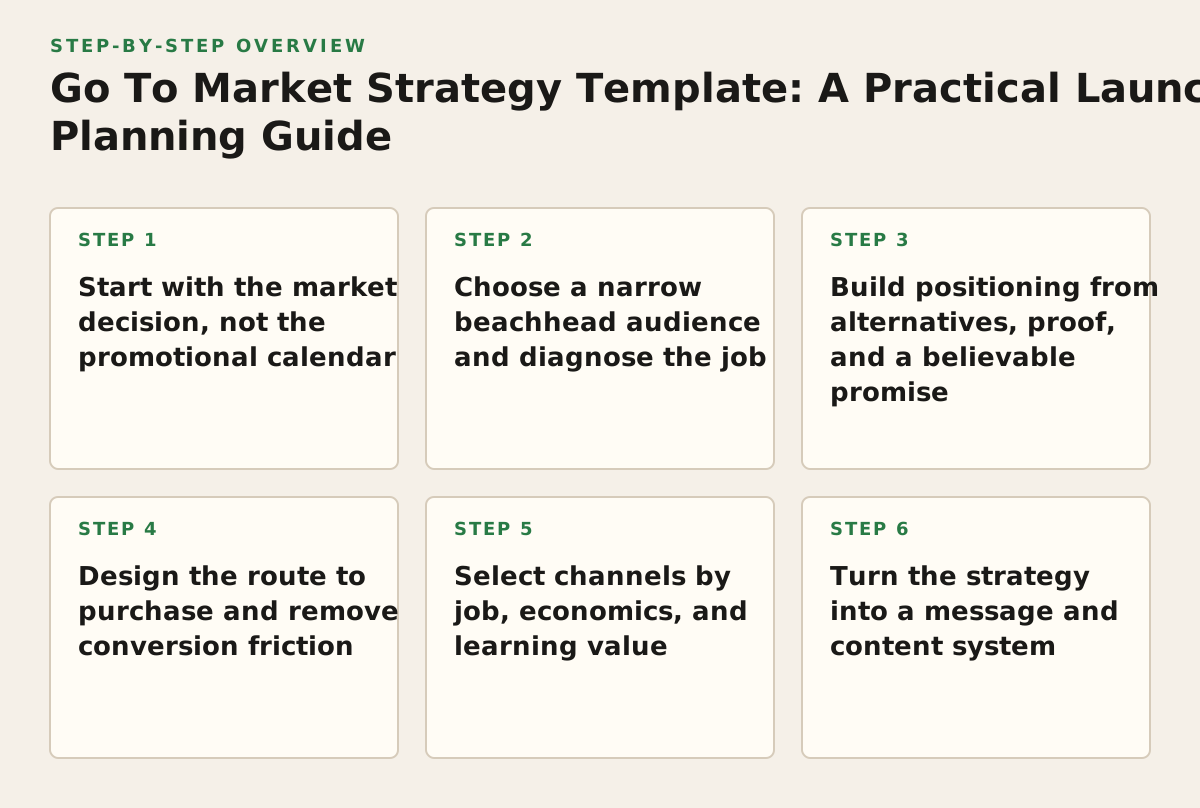
1. Start with the market decision, not the promotional calendar
When this applies: Use this principle before choosing channels, writing ad copy, or assigning daily tasks. It matters especially when a team has several possible audiences or when a client says, “We want to target everyone.”
Why it works: A go-to-market plan is a sequence of choices under limited time and money. Defining the decision first prevents the template from becoming a collection of activities. The initial decision might be “Can we acquire the first 30 qualified leads for a bookkeeping service in Riyadh?” or “Can this Egyptian accessories store sell a new product bundle to existing customers before spending on cold traffic?” Those are testable questions. “How do we make the brand famous?” is not.
Write the launch brief in one page
- Offer: What exactly is being sold, to whom, and in what form?
- Market entry decision: What must be learned or achieved before expanding?
- Initial segment: Which group has the clearest problem and easiest access?
- Commercial action: Is the desired action a purchase, booked call, application, trial, or store visit?
- Constraints: What cannot change, such as delivery geography, inventory, compliance review, or founder capacity?
- Evidence: Which customer behavior would support continuing, changing, or stopping the launch?
Failure mode: Teams often announce a launch date before confirming the operational promise. If an online store advertises same-week delivery but has no reliable stock count or fulfillment owner, paid traffic amplifies disappointment. A template should therefore include a “not ready yet” field. It is a valid decision to delay promotion until stock, payment, delivery, and customer support can handle the expected action.
Implementation example: A freelancer preparing a launch for a Saudi meal-preparation service might write: “During the first six weeks, validate whether office workers in north Riyadh will order a five-day lunch plan through WhatsApp after seeing educational short-form video and a clear menu page.” That statement identifies the audience, offer, channel hypothesis, conversion route, and learning period without pretending that every resident of Riyadh is equally valuable.
2. Choose a narrow beachhead audience and diagnose the job
When this applies: Use audience narrowing when the product is new, the budget is modest, the account has little historical data, or the content team cannot produce different messages for many segments. A narrow starting segment does not mean the business can never expand; it means the first message has a job to do.
Why it works: People respond to relevance, not to demographic labels alone. “Women aged 18–45” is a buying audience only if you can explain the problem, trigger, alternative, and decision criteria. A useful audience definition connects the person to a situation: a recent graduate applying for digital marketing jobs, a small retailer losing track of inquiries from Instagram, or a parent seeking structured online learning for a teenager.
Use the audience worksheet
- Situation: What is happening immediately before the person looks for a solution?
- Job to be done: What practical progress do they want?
- Current alternative: What do they use now, including spreadsheets, freelancers, competitors, or doing nothing?
- Cost of inaction: What time, money, risk, or frustration continues?
- Buying barrier: What makes them hesitate—price, trust, setup effort, delivery, proof, or lack of skill?
- Reachability: Which platform, community, search phrase, partner, or existing customer list can access them?
Do not confuse a persona with evidence. A persona is a working hypothesis; real search queries, customer questions, objections in messages, and sales-call notes are stronger inputs. For a beginner audience, “learn digital marketing” is too broad. “Build a campaign brief for a local business and understand whether the ad is reaching the right people” describes a more concrete job and leads to better content and offers.
Failure mode: Over-segmentation can create five weak campaigns before one useful message has been learned. If the product serves both freelancers and in-house marketers, start with the segment that has the clearest urgency or easiest access. Keep the second segment in a parking lot with a reason, not in the active campaign by default.
Implementation example: Suppose an Egyptian e-commerce brand sells reusable water bottles. Its first audience could be university students who commute and already buy practical accessories online. The message would focus on portability, leakage prevention, and delivery—not a generic claim about “a healthier lifestyle.” The team can later create a separate message for gym users after learning whether the product’s strongest reason to buy is convenience, design, or durability.
3. Build positioning from alternatives, proof, and a believable promise
When this applies: Positioning becomes urgent when customers can buy a similar product elsewhere, when the category is crowded, or when a new service sounds interchangeable with dozens of freelance offers.
Why it works: Positioning reduces the mental work required to answer three questions: “What is this?”, “Why this option?”, and “Why now?” It is not a slogan. It is a decision rule for landing pages, ads, sales scripts, social posts, and customer service. A strong position identifies a valuable difference that the business can actually deliver.
Complete the positioning block
For [specific segment] who need [urgent job], [offer] is a [category] that provides [primary outcome] through [credible mechanism]. Unlike [main alternative], it [meaningful difference]. We can support this promise with [proof].
The “mechanism” matters. “Better marketing” is vague; “a guided campaign workflow with daily practice tasks and feedback” explains how the offer may create value. “High-quality design” is also vague; “ready-to-use product visuals adapted for mobile product pages” is more specific. Avoid turning an internal feature into an outcome unless the customer understands the connection.
Proof can include a transparent process, demonstration, sample lesson, product material, customer explanation, qualification, or documented policy. Do not invent testimonials, results, customer counts, or performance percentages. If proof is weak, make the launch objective partly about collecting legitimate proof through interviews, samples, or a carefully scoped pilot.
Failure mode: Differentiating only through a discount attracts people who are waiting for the next discount. It also gives competitors a simple response. A lower price can be part of a launch policy, but the template should record what happens after the introductory period and why the buyer would remain.
Implementation example: A freelancer selling social media management to small restaurants might position the service around a specific operational problem: “A monthly content and response system for restaurants that receive daily inquiries but lose bookings in scattered messages.” The credible mechanism is a content calendar, response categories, escalation rules, and weekly reporting. The offer is more defensible than “we make attractive posts.”
4. Design the route to purchase and remove conversion friction
When this applies: Use this section when a campaign receives attention but few people complete the desired action, or when several handoffs exist between an ad impression and a sale. The route differs by offer: a low-cost product may need a direct checkout, while a professional service may need qualification before a call.
Why it works: Every handoff creates friction, delay, and information loss. A person sees a video, visits a profile, opens a landing page, sends a message, waits for a reply, answers questions, and receives a payment link. Each step can reduce completion. The go-to-market template should map the actual journey, not the journey the team wishes customers followed.
Map the minimum viable funnel
- Attention: What problem or trigger earns the first few seconds?
- Understanding: Where does the prospect learn what the offer does and who it is for?
- Trust: What evidence, explanation, policy, or demonstration reduces perceived risk?
- Action: What single next step should the prospect take?
- Qualification: What information is needed before a human or system responds?
- Fulfillment: What happens after payment, booking, application, or registration?
- Follow-up: How are undecided prospects and new customers treated differently?
For a product page, check whether the first screen communicates the product, audience, benefit, and next action. For a lead form, ask only for information that changes the follow-up. For WhatsApp sales, define response ownership and a response-time policy instead of assuming the founder will always be available. If tracking is limited, use a simple source question such as “How did you hear about us?” while improving the measurement system.
Google’s official Analytics documentation describes events as interactions that can be measured, which is useful when defining actions such as viewing a key page, submitting a form, or completing a purchase rather than relying only on impressions. See the Google Analytics event documentation (2026) when translating the journey into a measurement plan.
Failure mode: Adding more fields, pop-ups, and persuasion blocks can make a page look more complete while making the action harder. If a beginner wants to enroll in a course, forcing them to schedule a consultation may add unnecessary friction. If a high-value consulting service accepts everyone instantly, removing qualification may create poor-fit calls. The right route depends on risk, price, complexity, and the cost of a bad customer.
Implementation example: For a digital course, the route might be short video lesson → course page → syllabus and practical-task preview → payment or registration → onboarding email. For a campaign-management service, it might be case-relevant content → service page → qualification form → discovery call → proposal. The template should state why each step exists and who owns it.
5. Select channels by job, economics, and learning value
When this applies: Use channel selection when a team is tempted to publish everywhere or when a client asks for Facebook, Instagram, TikTok, Google, email, and influencers without identifying the role of each channel.
Why it works: Channels are not interchangeable containers for the same message. Search can capture existing intent; short-form video can create problem awareness; email can develop an owned relationship; partnerships can transfer trust; paid social can test creative angles and reach defined audiences. Choose a channel because it performs a job in the buyer journey, not because it is popular.
Score each channel before committing
| Channel role | Best initial use | Evidence to collect | Main constraint | Starting decision |
|---|---|---|---|---|
| Search | Capture a clearly expressed problem or product need | Relevant queries, qualified visits, completed actions | Low demand for a new category | Use when people already search in the target market |
| Organic social | Explain, demonstrate, and build familiarity | Saves, replies, profile actions, assisted inquiries | Requires consistent useful content | Use when the offer benefits from education or visual proof |
| Paid social | Test audience and creative hypotheses at controlled scale | Qualified actions, message quality, landing-page behavior | Can optimize toward cheap but weak actions | Use only with a defined conversion and feedback loop |
| Email or messaging | Follow up with known prospects and customers | Replies, bookings, purchases, repeat actions | Requires permission and useful follow-up | Use when the decision needs reminders or education |
| Partners and creators | Borrow contextual trust and reach a niche community | Tracked referrals and lead quality | Attribution and brand-fit risk | Use when the partner already serves the chosen segment |
The table is a prioritization tool, not a promise of performance. Start with one primary acquisition channel and one support channel when resources are limited. A small store might use search and Instagram content; a course provider might use educational video and email; a B2B freelancer might use LinkedIn content, referrals, and a qualification page.
When using advertising platforms, separate the campaign objective from the business objective. Meta’s official business guidance explains that campaign setup includes choosing an objective aligned with the desired business result; the relevant choice should therefore be connected to the actual action, not merely the easiest metric to obtain. Consult Meta’s campaign objectives guidance (2026) while documenting that choice.
Failure mode: Optimizing for cheap reach when the business needs sales produces a report that looks healthy but does not answer the commercial question. Another failure is launching five channels with one person responsible for all content, replies, reporting, and fulfillment. Capacity is a channel-selection constraint. If a channel cannot receive a useful message, timely response, and measurable next step, it is not ready to be primary.
Implementation example: A Saudi home-services freelancer might select Google Search for people actively seeking a service and Instagram for before-and-after explanations. The search campaign captures intent; Instagram gives prospects a reason to trust the provider. TikTok may remain a later experiment because its content demand could exceed the freelancer’s weekly production capacity.
Use Marketing tools to choose marketing tools for media buying, creative strategy, conversion optimization, and performance marketing workflows. That selection helps you operationalize a go-to-market strategy instead of collecting software that does not improve execution.
6. Turn the strategy into a message and content system
When this applies: This principle applies when different team members produce inconsistent claims, when social content receives attention but does not move people toward a decision, or when a freelancer needs a repeatable system for several clients.
Why it works: A content system gives every asset a strategic role. It connects the audience’s stage of awareness to a message, proof type, format, and call to action. Without that connection, teams mistake volume for progress and publish educational posts that never explain the offer.
Build five message territories
- Problem recognition: Show the cost or frustration of the current situation.
- Education: Explain a concept or mistake in language the audience can use.
- Mechanism: Demonstrate how the product or service creates the promised outcome.
- Proof: Show process, examples, materials, qualifications, or legitimate customer evidence.
- Decision: Clarify fit, price structure when available, next steps, limits, and urgency without artificial pressure.
For each territory, define a hook, one central idea, a proof element, and a single call to action. A social media manager can then create a weekly matrix instead of asking every morning, “What should we post?” A beginner-focused marketing course might publish a post explaining campaign objectives, a screen-recorded exercise, an example brief, a common beginner mistake, and an invitation to inspect the syllabus.
Keep claims proportional to proof. “Helps you practice building a campaign brief” is safer and clearer than “guarantees a marketing job.” A product may be durable without being indestructible; a course may be practical without promising employment. Clear limits can increase trust because they help the right buyer self-select.
Failure mode: Repeating the same sales message in every format creates fatigue and teaches the audience nothing new. The opposite failure is making every post purely educational and hiding the offer. A useful rule is to connect every educational asset to a decision the customer may eventually need to make, then provide a relevant next step.
Implementation example: For an online store selling skincare products, one content territory can explain how to choose a routine by skin concern; another can demonstrate texture and application; another can answer delivery and returns questions. Each piece should lead to the appropriate product collection or message route, not to a random homepage.
7. Allocate budget, people, and experiments with explicit guardrails
When this applies: Use this principle when launching paid advertising, outsourcing creative work, or deciding whether to scale a campaign. It is particularly important for small businesses that cannot afford to treat all spending as a learning exercise.
Why it works: A budget is a set of hypotheses with a maximum acceptable cost and an owner. Separate investment for learning from investment for repeatable acquisition. Early spending may reveal which audience or message earns qualified attention; later spending should be justified by a more reliable route from attention to revenue or another agreed business outcome.
Write a test card for every experiment
- Hypothesis: What do we believe and why?
- Change: What one variable will be different?
- Audience: Who will see it?
- Primary outcome: What action matters commercially?
- Guardrail: What must not deteriorate, such as lead quality, response time, or refund rate?
- Decision rule: What will we do if the evidence is promising, mixed, or weak?
- Owner and date: Who reviews the evidence and when?
Any monetary amount or threshold in a plan should be labeled as an illustrative starting policy, not a universal benchmark. For example, a small shop might reserve an illustrative 70% of its launch advertising allocation for the leading hypothesis and 30% for controlled alternatives. Another business may choose a different split because its sales cycle, margin, and available creative are different. The important mechanism is that experimentation has a limit and a decision date.
Know the difference between a platform metric and a business metric. Impressions and clicks describe delivery and interest; qualified inquiries, completed orders, gross margin, repeat purchase, and attended consultations describe commercial progress. If the sales team does not record outcomes, the marketing team cannot learn which sources create value.
Failure mode: Changing the audience, creative, landing page, offer, and budget simultaneously makes the result uninterpretable. Another failure is stopping a campaign after a very small amount of data without checking tracking, delivery, relevance, and sales follow-up. A test does not need to be enormous, but it does need a defined observation period and a meaningful action threshold appropriate to the business.
Implementation example: A freelancer may test two message angles for a course: “learn the fundamentals from zero” versus “practice campaign management through assignments.” The landing page, audience, and call to action remain stable for the illustrative test period. The review looks not only at clicks but also at syllabus views, registration completion, and the questions asked by prospects.
8. Measure the launch as a learning loop, not a dashboard ceremony
When this applies: Use this framework when stakeholders request reports, when multiple tools show conflicting numbers, or when the team needs to decide whether to improve the offer, creative, channel, or follow-up.
Why it works: A metric becomes useful only when it changes a decision. Build the measurement chain from business outcome backward. If the objective is paid enrollments, the chain may be qualified visit → course-page engagement → registration start → payment completion → attendance or activation. If the objective is service clients, it may be inquiry → qualified lead → attended call → proposal → signed agreement.
Assign metrics to the part of the system they diagnose
- Reach problem: The right audience is not being exposed to the message.
- Relevance problem: People see the message but do not engage or continue.
- Conversion problem: People show intent but do not complete the action.
- Trust problem: Prospects ask repeated objections or abandon after learning details.
- Operations problem: Sales, delivery, or support fails after acquisition.
- Retention problem: Customers do not return, complete, or recommend as expected.
Keep a decision log with the date, evidence, interpretation, action, owner, and next review. This is valuable for freelancers because it prevents a client from judging every week in isolation. It is also valuable for students because it turns campaign work into a portfolio case: the case shows not only the final creative, but how the marketer selected a segment, identified friction, and changed the plan.
Use consistent naming for campaigns, audiences, creative versions, and landing pages. If a message arrives through WhatsApp, record the source with a simple structured field. If offline activity matters, use a code or question that staff can apply consistently. The measurement method should be simple enough to survive busy periods; a sophisticated dashboard that nobody updates is less useful than a reliable spreadsheet.
Google Ads’ official documentation distinguishes campaign goals and conversion actions as part of setting up measurement for advertising objectives. Review the Google Ads conversion tracking guidance (2026) when deciding which completed actions should count as conversions and which interactions should remain diagnostic.
Privacy and consent also belong in the measurement decision. Do not collect personal information merely because a form allows it. Explain why information is requested, limit access, retain only what the workflow needs, and follow the applicable laws and platform requirements in the country where the audience is located. A measurement plan that damages trust is not a successful go-to-market plan.
Failure mode: Reporting the most flattering metric hides the actual bottleneck. A campaign can have a strong click-through rate while producing poor leads because the promise is too broad. Conversely, a low click rate may be acceptable if the offer is high-value and the small number of visitors convert well. Always pair an attention metric with an outcome metric and a quality check.
Implementation example: If a course campaign generates many registration starts but few completed payments, the next action is not automatically “increase the budget.” Check payment friction, missing information, mobile usability, trust questions, and follow-up timing. If payment completion is healthy but attendance is weak, the go-to-market problem has moved into onboarding and fulfillment.
Implementation plan: complete the template in seven working stages
Use the following sequence rather than filling every section at once. Each stage produces an artifact that makes the next decision easier.
- Stage one—write the decision: In one sentence, state what the launch must prove, for which offer, in which market, and through which commercial action. Record constraints such as geography, inventory, team capacity, and service availability.
- Stage two—interview the evidence: Review customer questions, support conversations, search language, competitor alternatives, and existing sales notes. If evidence is unavailable, label assumptions clearly and schedule interviews or a small discovery activity before making large claims.
- Stage three—select the beachhead: Rank segments by urgency, reachability, ability to pay, fit with the offer, and cost of serving. Choose one primary segment and document why the others are deferred.
- Stage four—draft the position: Complete the audience, job, category, outcome, mechanism, alternative, difference, and proof fields. Remove claims that cannot be demonstrated. Create three message angles that express the same position in different language.
- Stage five—map the route: Draw the actual path from first exposure to purchase or booking. Assign an owner to each handoff, define the response policy, and remove steps that do not improve trust, qualification, or fulfillment.
- Stage six—choose the channel mix: Give every selected channel one job, one audience, one content or advertising format, one call to action, and one diagnostic metric. Start with the smallest workable combination that the team can maintain.
- Stage seven—launch, review, and decide: Run the agreed test, verify tracking, record qualitative feedback, and review both marketing and operational outcomes. Decide whether to scale, refine the offer, change the message, repair the route, or stop the experiment. Document the reason so the next campaign begins with knowledge rather than memory.
For beginners who need structured fundamentals and applied practice, كورس إبدأ ماركتنج can support the early stages of audience, offer, and campaign planning. Learners who specifically manage pages and social content may also compare that foundation with دبلومة السوشيال ميديا before choosing a specialization.
Use this template as a working document: update assumptions when evidence changes, preserve previous decisions, and never let a calendar replace a commercial hypothesis. If you want guided practice, daily follow-up, and courses built for digital marketing and social media skills, explore YSA Academy as the next step in turning the plan into repeatable professional work.
Authored with NotFair SEO